- Online Art Gallery
- Buy Art Online
- Wall Paintings
- Art Marketplace
- Worldwide Shipping


15 Most Famous Abstract Painting in Today’s Time

May 13, 2022
0 comment(s)
What is The Art of Abstract Painting?
Abstract painting is an art where the artist employs a combination of a visual style, color as well as line to produce art that might nowhere exist in the world. On or after the time of the renaissance till the mid of the 19th century, Western art was grounded by the logic of vision and an effort to recreate an impression of physical reality. At the end of the 19th century, maximum artists were urged to bring forward a new type of art that depicts the major changes emerging in other fields such as science and technology. Afterward, each painter started work solely on his or her conceptual ideas from a wide range of perspectives. This shows the societal and cognitive obsession of Western society with every single field. Now one must be thinking about the lines that how that work and who is the father and many more questions so better let us talk about that.
The Key Themes
The Initial Signs: Abstract expressionism, Futurism, and suprematism, all are the different antecedents of abstract painting.
The Time Period: abstract Contemporary painting emerged in the 20th century. This was absolutely fundamental for ahead of its time. The abstract painters started to create simple arguments that had minimum or null resemblance to the ‘Physical’ world.
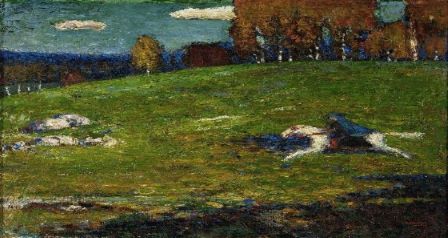
The Founder of Abstract Painting: The very first artist who brought forward the Abstract painting to society is like a puzzle to solve although Wassily Kandinsky has frequently been attributed by researchers for the “Art of Floating”, illusionist forms at the beginning of 1912. After the introduction of his art in the Armory show in 1913 brought Abstract painting to the USA.
The Floating Art of Wassily Kandinsky (1903)
Abstract Painting in Today’s World: In the contemporary world Abstract painting exists in a variety of ways in the world of art. Currently, Abstract paintings exist in both two-dimensional and three-dimensional. It might be large or modest in size. Abstract painting may also be created using a variety of materials and in a variety of areas. It is presented in concert with realistic painting or all alone. In their illusionistic work, artists frequently emphasize various visual elements such as color, form, texture, scale, and much more.
Why Should One Care About Abstract Painting? Abstract art's enduring appeal stems from its capacity to spark our interest in the limits of our imagination and the possibility for us to create something truly unprecedented in history. A significant question that your mind might ask is about the creation of the abstract painting and whether the very form of painting is even genuine or not at least for you. Your mind might be stuck in there since you are still wondering “whether the Abstract painting is a real ‘art’ whatsoever?
The second possible question that you might ask yourself is does one need to have the master of realism in order to work abstractly? And at last, it might be you who is worrying about your friends and family who might not approve it. To answer the above questions Firstly, quite a long ago the decision was made over abstract painting which was that Yes, Abstract art has always been and will be regarded as a "genuine" art genre. As far as the second question is concerned, the answer is ‘No’, one need not to have a degree in realism to create abstract art. Furthermore, no one verifies your "artistic autonomy" qualifications at the door. For the third question, if you make sure everything from your friends and family and leave everything on them to decide for you then you would not consider producing art and its accomplishment. Throw away all your fear of approaching judgment. Be yourself and make the decisions on your own since you cannot make everyone.
15 Most Famous Abstract Painting in Today’s Time
Let’s now talk about the most famous abstract painting people still love the most. These are the paintings selected after a well-research study and are voted the most on different websites therefore we listed them in the most famous abstract paintings.
Che Guevara (2015) by Gheorghe Virtosu
Che Guevara from 2015 is an exceptional example of Gheorghe Virtosu's abstract work, demonstrating the innovative creative genius and awareness of the modern societal reality that has characterized Virtosu as the most prominent and influential artist of the 21st century. The above abstract painting is indicative of abstract depictions of the famous global figures, providing powerful visual notions for the contemporary social realities and situations that serve as the fundamental source of motivation for Virtosu's art.

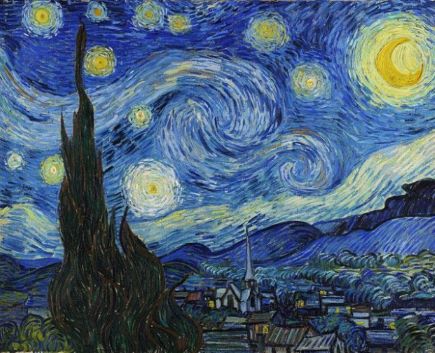
The Starry Night by Vincent Van Gogh
In second place we have The Starry Night by Vincent. When you hear the phrase "starry night," you would imagine a night vision with a myriad of sparkling stars, which is precisely what the title implies. However, Vincent van Gogh had a diverse vision than merely a night sky with stars; he created something completely out of this world.
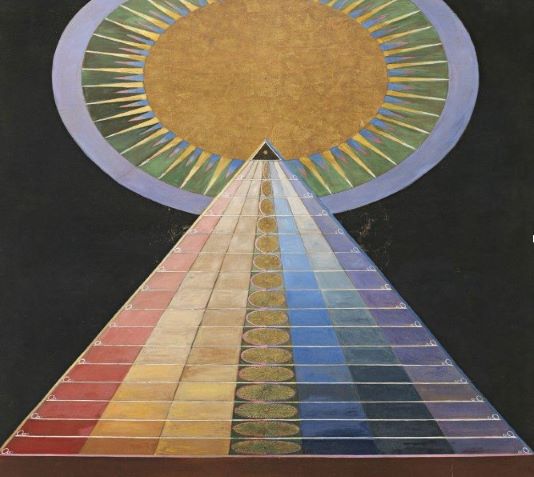
Group X, No. 1, Altarpiece by Hilma Af Klint
The world appears to be ready for Hilma Af Klint and the inherent message of independence that her narrative portrays. Throughout that time, women's subject matter was constrained by the prosaic, the residential worlds of creatures and plants, to which they were compelled to restrict themselves. Nevertheless, as a means, Af Klint was allowed to operate on a cosmic scale. Her reappearance coincides with the popular revival of the witch as a feminist figure. The witch, like Af Klint, signifies physical and psychological freedom - a character with hidden knowledge gained beyond the established authoritative institutions.
Modern Pollination (2016) by Gheorghe Virtosu
Gheorghe Virtosu, one of the most important artists of the twenty-first century, cultivates a distinctly Own style distinguished by compelling pictures that convey the subtle fascination and psychological demands of modern reality. His investigation of the mundane and his in-depth study of the mind go deep behind the extraordinary surfaces of classic Societal themes like politics, war, injustice, gender, and societal concern. Virtosu's work goes beyond basic story description in quest of the metaphorical and intriguing, despite its essential dedication to abstraction. His artwork is a type of catharsis, a very intimate manifestation of his mental ideas as a reaction to the physical environment.
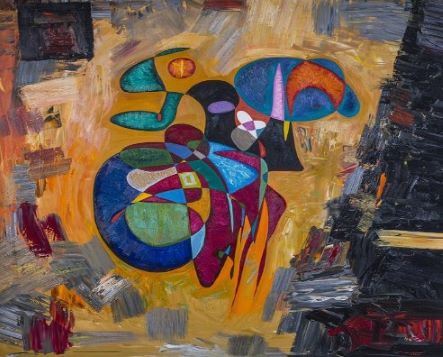
Virtosu exhibits a sophisticated connection between material and depiction whilst generating a dynamic setting. When we consider the four thorns emerging from the back of the head, this view acquires strength. Three are straight projections from his head, while the other two show the grey traveling along with the thorns. This is an artistic picture of Einstein's mind, and it is flowing with thoughts that acquire form and shape in the external environment.

Mondrian's delicate and perfect balance, which he carefully pursued and attained in the above painting is considerably more than a scholastic exercise. Instead, the paintings reflected a microcosm of the artist's socialist fantasy land of the world. Harmony via the equivalency of nature and mind, of that which is individual and that which is worldwide, of the feminine and masculine. This basic belief of Neo-Plasticism might be attained not only in art but also in society.

There are possibly no stronger graphic statements of the distinctive, exciting, and spectacular age of emancipation and success in American painting in New York in the 1950s than Franz Kline's huge, energetic, story-driven black-and-white paintings created during 1950 to 1961. Kline's works are the definitive 'Abstract Expressionist' works, which seem to contain all the power, passion, independence, and vitality exhibited by this important and legendary era in the history of American 20th Century Art and compress it into one remarkable plain area.

Copyright © IndianArtZone. All rights reserved.