- Online Art Gallery
- Buy Art Online
- Wall Paintings
- Art Marketplace
- Worldwide Shipping


10 Influential Self Portraits That Changed the Face of Art
May 13, 2022
0 comment(s)
Almost every artist, from novice to expert, has tried a self-portrait at a certain point throughout their career. The adaptability of this genre is demonstrated by famous self-portraits done by the most significant personalities throughout the history of art. Although this long-established genre of portrayal extends back to ancient times, it wasn't until the Early Renaissance in the mid-15th century that artists started to display themselves as the central focus increasingly regularly. Numerous artists, sculptures, and graphic artists have used mirrors as a technical tool to reproduce their personal image in a range of distinct and unique ways for a number of motivations. As they grew older, some people began to create repeating self portrait paintings in order to record their ever-changing selves.

Picasso’s “Self-Portrait Yo Picasso” by Picasso Sold for $47.9 Million in 1989
Yo Picasso, completed in June 1901, is the first of three self-portraits completed that year and depicts a 19-year-old Picasso observing himself with extreme pride. Picasso's style evolved throughout time, and his self-portraits got progressively abstract.
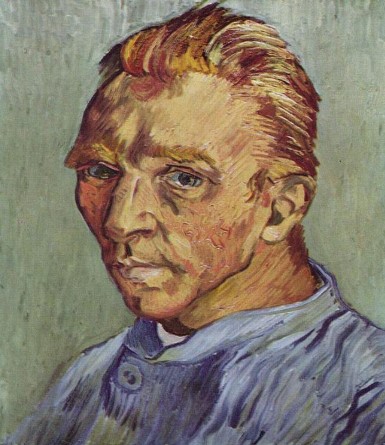
“Portrait of an Artist Without His Beard” by Vincent by van Gogh
The depiction of an artist "Portrait of an Artist Without His Beard," painted in 1889, sold for $71.5 million in New York City in 1998. It was the second-highest price ever paid for a van Gogh at auction, and the third-highest price ever paid for any painting sold at auction. What distinguished van Gogh's "Picture of an Artist Without His Beard" was that it was his sole self-portrait without a beard, and it is thought to be his final self-portrait. Whilst incarcerated, he created this painting for his mother, Anna Cornelia Carbentus van Gogh, on her 70th birthday. He tried to convince her that everything was alright. Tragically, he attempted suicide shortly thereafter.
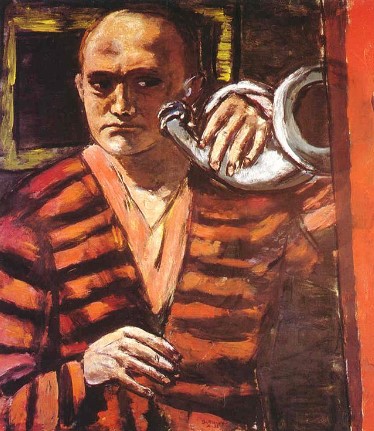
Self-portrait with Hunting Horn by Max Beckmann
Max Beckmann, a German artist, drew "Self-portrait with Hunting Horn" in 1938 while living in banishment in Amsterdam after the Nazis labeled him a worthless artist. In 2001, the artwork earned $22.5 million. Beckmann represents himself alone in a constrained, small room, carrying a Waldhorn (a Germa hunting horn) in his left hand and wearing a black-and-red-striped housecoat in "Self-Portrait with Hunting Horn."
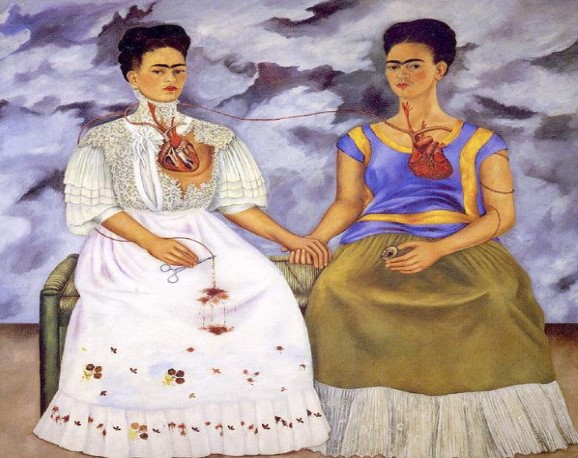
(The Two Fridas, a 1939 self-portrait by Mexican artist Frida Kahlo depicts the artist's pain after being divorced from her husband)
The development in prominence and availability of photographing was also a major role in the emergence of fresh perspectives in Modern art paintings. The portrait of self The Two Fridas is one of Kahlo's best-known and recognizable artworks. The picture, which depicts two incarnations of Frida Kahlo reclining together, represents her anguish during her divorce from Diego Rivera and following the transition to her new persona. Frida is dressed in white European-style clothing on the left, which she wore before her marriage to Rivera.
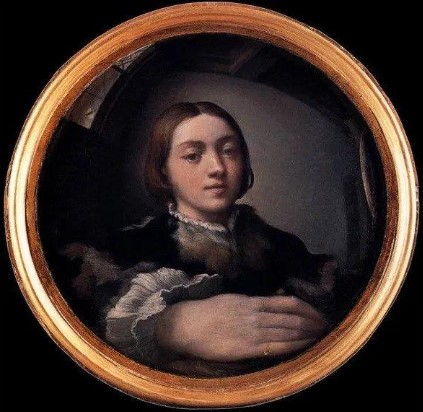
Parmigianino - Self-Portrait in a Convex Mirror, 1524
Parmigianino, an Italian painter of the late Renaissance, used a convex mirror to produce this portrait. During his lifetime, he was attracted by distortion. The background of this picture, which depicts the warped image of a young artist in the center of a room, is overshadowed by the significantly larger artist's hand twisted by the mirror. With charming and stunning characteristics, the artist's face is remarkably peaceful. To emulate the arc of the mirror, the work is created on a convex panel.
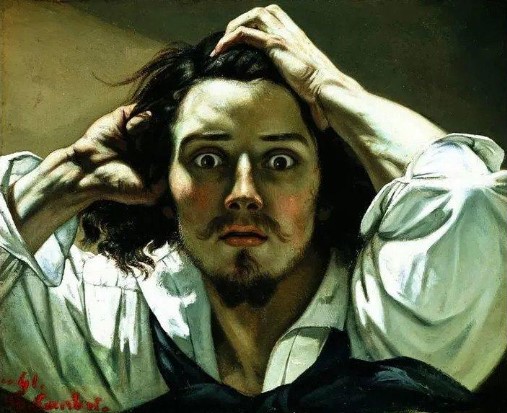
Gustave Courbet - Le Desespere, 1845
The artwork Le Désespéré, among the finest renowned self-portraits of all time, depicts the artist Gustave Courbet as a young man in misery. The artist's close-up depicts the artist's eyes wide open, piercing the spectator. The subject appears to burst out the canvas, painted with a variety of colors. It's unknown if the painting's depiction of melancholy was inspired by the artist's actual feelings or was only a theoretical argument. Normally, portraits were painted vertically, but Courbet used a landscape aspect for his picture. He is thought to have been especially fond of this work, as he has carried it with him to banishment in Switzerland.
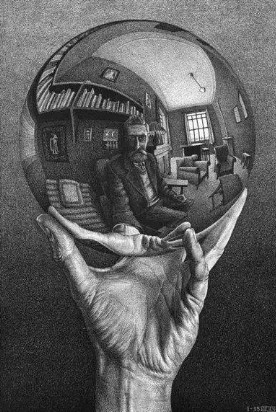
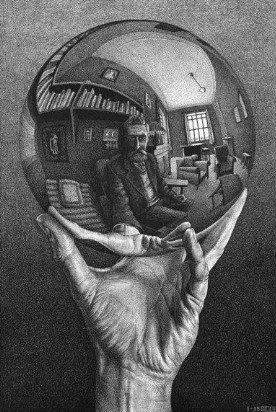
M. C. Escher - Hand With Reflecting Sphere, 1935
M. C. Escher, a Dutch artist, was interested in odd standpoints and what he called "mental imagery," which was frequently based on theoretical principles. Hand with Reflection Globe, commonly referred to as Self-Portrait in Spherical Mirror, is a lithograph that portrays a hand holding a reflection sphere through which we can view the artist and his environment.
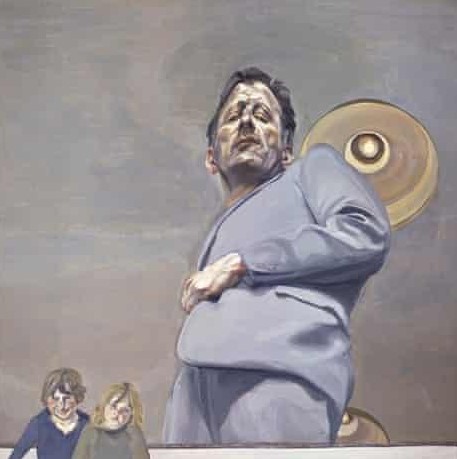
Lucian Freud – Reflection With Two Children (Self-Portrait) (1965)
Similarly in the list of influential self-portraits further we have the artwork of Lucian. In this unsettling artwork, the artist is a great father figure. Shown in a reflection in the mirror, he overshadows his small children. It is a picture of detached and uncomfortable self-consciousness. Since Parmigianino's time, mirrors have been useful components for self-portraiture. That fundamental truth is rendered brutally obvious in this and other Freud paintings when the artist calmly sees his mirrored image. He appears to be painting a horrific unknown person. Freud's self-portrait displays his keen feeling of the misery of being a human at its most intense.
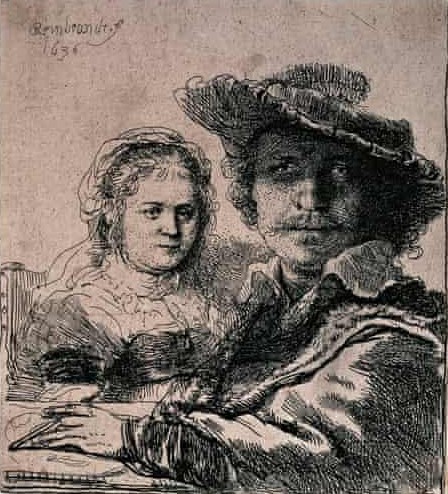
Rembrandt – Self-Portrait With Saskia (1636)
The artist shows us everything in this engraving, - how he creates and what he lives for. In reality, for Rembrandt, painting and life are magnificently inseparable. He is blissfully relaxing at home with his wife, Saskia, their shared joy evident. His shaded face and sketching hand look at their merged picture in a mirror, revealing art as a part of life rather than a distant formal activity.
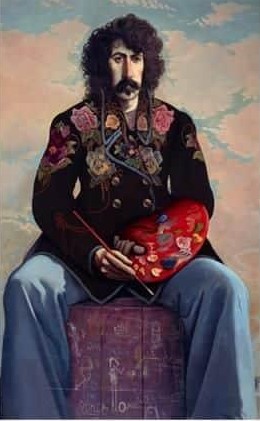
John Patrick Byrne – Self-Portrait in a Flowered Jacket 1973
To produce useful work, he integrated his artistic talents as a theatre designer, writer, and artist. He was the man behind "The Marble Boys," which investigates the life of working-class Scots, and he authored a classic television series called "Tutti Frutti," a 6-part drama series, in the 1980s. The artist's innumerable protean self-portraits over his career strongly imply a changing, if not adaptable, identity. Byrne is noted for his different contexts and facets, faces and dispositions, situations, and emotions, in addition to his literary skills. The lighthearted mood that may be seen in his paintings is tinged with sadness.
Copyright © IndianArtZone. All rights reserved.